
Photo courtesy of @anahi on Instagram. Collage and animation courtesy of Noor Bendek @noorbendek
Whimsymaxxing this, bedazzled that…okay, but do you know Anahí? No Manners looks back on Anahí and Mia Colucci’s style legacy and how they shaped the style sensibilities of an era.
More than 20 years after its premiere, Mexican soap opera Rebelde (2004) remains a touchstone of Latin American pop culture. The show—responsible for launching RBD, one of the biggest music sensations of the 2000s, to stratospheric fame—left a legacy of pop stardom, music and Y2K aesthetics across the Americas, Europe and places as far away as Turkey, Japan and the Philippines.
With a star-studded cast, an associated music project that people keep revisiting even 22 years later and fashion statements that catered to different demographics and tastes, Rebelde embodied the spirit of the noughties to a T.
Among the show’s many contributions to the pop culture catalog, one of its most significant was introducing leading lady and RBD’s vocalist, Anahí (playing Mia Colucci on screen) as the ultimate Y2K and McBLing icon in Latin America. For the millions who are somehow acquainted with the region’s pop culture, Anahí and the character that cemented her to global acclaim are prime examples of the optimism, slightly camp maximalism and whimsy that marked the early aughts.
The current noughties comeback, gem-maxxing craze and burgeoning whimsycore movement can’t be described as anything but the revival of the same aesthetic values and visual language that made Anahí and her character, Mia Colucci, cultural juggernauts.
This is how Anahí turned Mia Colucci into a generational icon
In the early 2000s’ Mexico, Anahí, born Anahí Puente Portillo, wasn’t only a seasoned actress and singer already known for her pop bangers such as “Supernemorándome” and roles in prime-time telenovelas, including Primer amor, a mil por hora and Clase 406. Since a young age, the multi-hyphenate was also a budding style icon.
Enter Televisa’s Rebelde and the star would write a chapter in pop culture with her portrayal of rich girl Mia Colucci. Reprising a character previously introduced in the Argentinian TV series Rebelde Way (a phenomenon of its own not addressed in this article), Anahí secured a place in fashion and music history.
Equal parts sweetheart and mean girl, Mia Colucci was the Queen Bee ruling the halls of Elite Way School, the boarding institution where most of Rebelde’s plot unfolded, with a wardrobe that teens worldwide wanted to replicate.
The character’s association with fashion wasn’t coincidental.
Conceived as the heiress to a fashion empire and the most popular girl in school, Mia was an informed fashionista whose witty one-liners often included mentions of brands like Carolina Herrera, Prada, and Armani, as well as pop culture icons such as Paris Hilton and Cameron Díaz.
Naturally, each of the character’s sartorial choices served teen queen aesthetics. Her closet spanned full pink tracksuits, waist chains, graphic tees and pleated micro skirts paired with knee-high boots and exposed midriffs. In between, the character also rocked low-rise jeans, cargo pants, and, in later seasons of Rebelde, midi skirts.


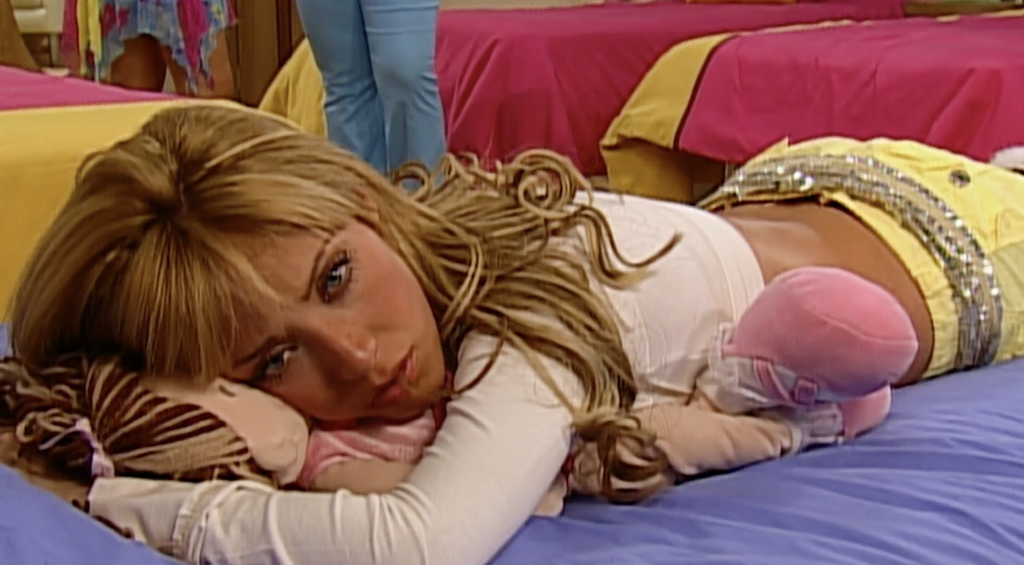
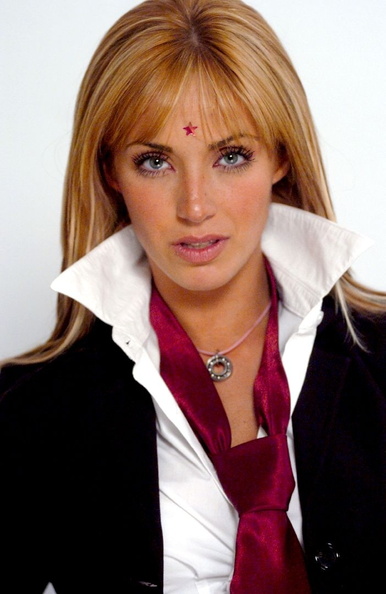
Beauty-wise, Anahí herself ideated what became Mia’s ultimate style signature: a star decal (or rhinestone on occasion) on the forehead. In various interviews, Anahí has explained that, as a character, Mia probably believed her existence alone deserved a reward. So, Anahi proposed the idea of wearing a star—a nod to the gold star reward system reinforced on Millennial children—to make her character stand out.
Paired with body glitter, the iconic glitzy adornment prompted a true rhinestone craze across Latin America. “Suddenly you could find fashion editorials with [models wearing] stars on the face, or you saw girls who also wanted to imitate her, sporting that star,” fashion publicist and producer Azahel Marmolejo told NYLON in 2024.
Off camera, Anahí’s style didn’t stray far from Mia’s.
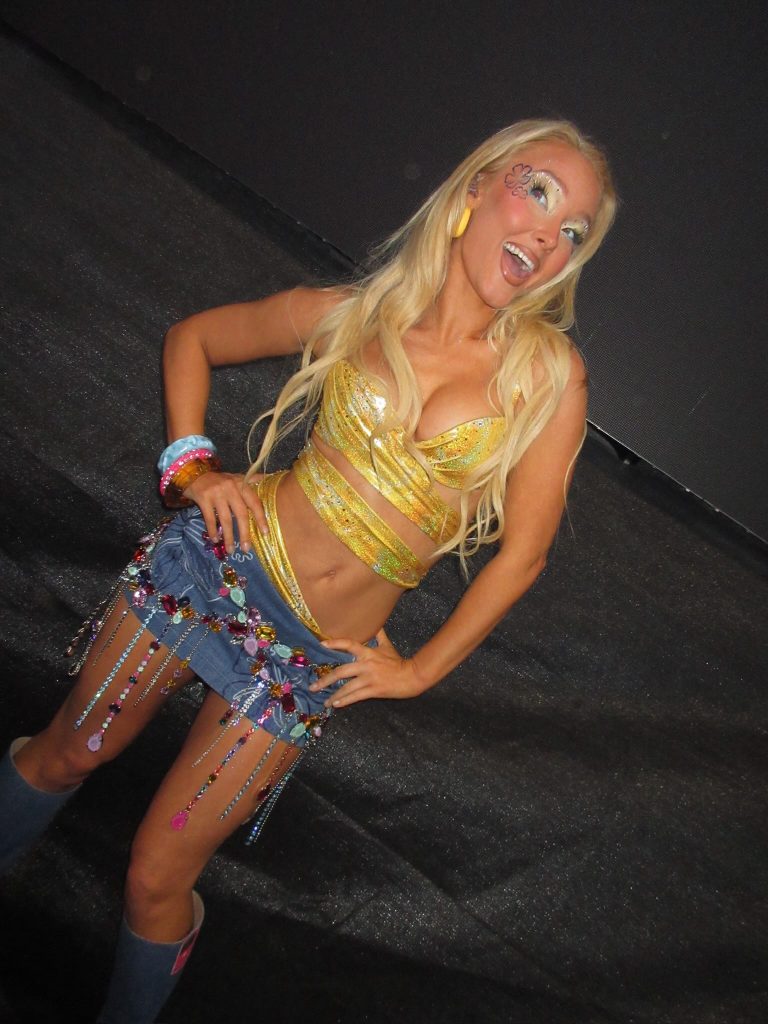
While performing as part of RBD, Anahí took things up a notch. Her stage looks were never complete without elements from the fashion zeitgeist—think butterfly accessories, micro skirts a la Miu Miu, flashy crop tops, charm belts, all of them, often embellished with rhinestones and Y2K motifs.
The singer was also a loyal devotee of glittery and bedazzled beauty. Today, celebs such as Zara Larsson and Kylie Jenner might be bringing back the rhinestone obsession, but back in the day, Anahí, alongside 2000s divas such as Christina Aguilera and Mariah Carey, spearheaded the trend.
In Latin America, Anahí pioneered bedazzled midriffs, facial decals, rhinestone makeup and shimmery skin. She complemented these beauty statements with frosted eye shadow, pink blush, metallic gloss and graphic liner.
Throughout the 2000s, or at least during Rebelde’s run, Anahí would keep her character’s persona and style deeply intertwined with her own.
That’s why Mia and Anahí’s legacy is rarely separated.
“Rebelde’s characters will accompany all the cast for the rest of their careers.[…] Anahí, who at 21 was already a star, cemented her career with Mia. For some, it was difficult to separate her from the character,” explains pop culture and entertainment journalist Alejandro Puga, a long-time fan and authority on all things Rebelde.
For Puga, however, the impact of Anahí’s Mia Colucci portrayal went beyond mere aesthetics. “She was a character built on the beauty standards of that era—a kind of Latin Paris Hilton, Nicole Richie, Hilary Duff, and Britney Spears combined into one. Mia, in short, is the most representative character of the decade’s youth, both for her values and her inconsistencies. She embodied the ideal of beauty and life dictated by the magazines of that time.”
As Puga points out, Anahí and Mia Colucci’s aesthetics were so impactful and recognizable that even now, they transport people back to the 2000s and influence showbiz. They are remembered as a picture-perfect representation of the 2000s value system, celebrity culture and aesthetic standards.
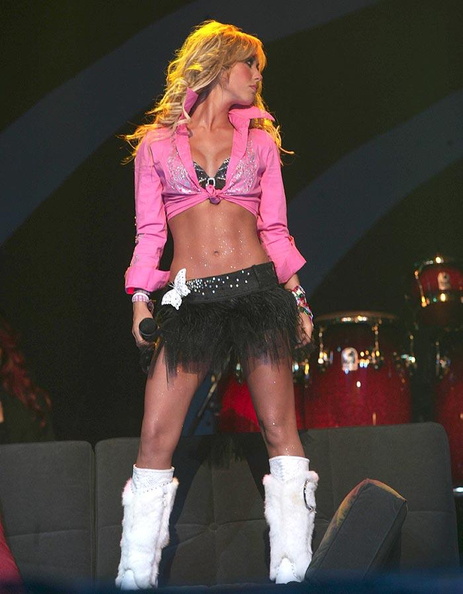
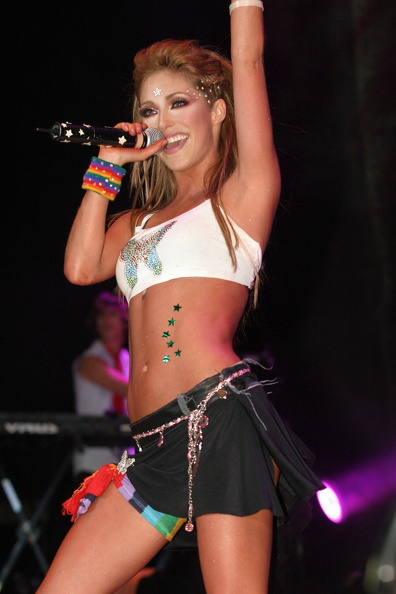
Anahí and Mia’s legacy has not waned over time.
Between nostalgia and the recurrent throwbacks to the noughties, homages to the Mexican actress and her portrayal of Mia Colucci have become commonplace, not only in the fashion arena, but also as icons of the cultural scene. Need proof? Look no further than the viral social media posts featuring the early aughts Anahí or the shout-outs from world-famous celebrities to her and her character.
In 2021, Colombian singer J Balvin dropped some rap verses dedicated to Mia Colucci in a remix of Ty Dolla Sign’s “Spicy.” Meanwhile, Puerto Rican sensation Bad Bunny and Colombian star Karol G have recognized RBD’s legacy (with specific nods to Anahí) by paying homage to the group’s biggest hit, Sálvame.”
Bad Bunny sang Anahí’s verses on a live stream, prompting a social media craze, while Karol G went the extra mile and invited Anahí onstage during one of her concerts in Mexico. For the occasion, the singers went down memory lane, wearing matching pink cowboy hats, similar to the one Anahí originally donned in the music video for “Sálvame.” Mia’s signature star decal on the forehead was also an inescapable detail as Anahí belted the break-up anthem.
In the style arena, Anahí and Mia’s style belongs in the mood board of trends, runway and pop culture moments.
Brazilian star Pabllo Vittar, for example, has reenacted Mia’s most iconic fashion moments more than once. First, dressing up in the Elite Way School uniform—star sticker on the forehead included. Then, by clipping a pink flip phone to a pair of high-knee boots.
This quirky styling hack (tucking the ultra-famous Motorola V3 Razr into the shaft of a pair of designer boots) was first popularized in the second season of Rebelde on Anahí’s suggestion and has gained traction in pop culture over the years.
Motorola itself, paid tribute to the phone-on-the-boot styling when the brand relaunched the Motorola Razr phone in the 2020s. Most recently, Zara Larsson, the current queen of whimsical style and all things Y2K, nodded to Anahí and Mia Colucci’s fashion legacy
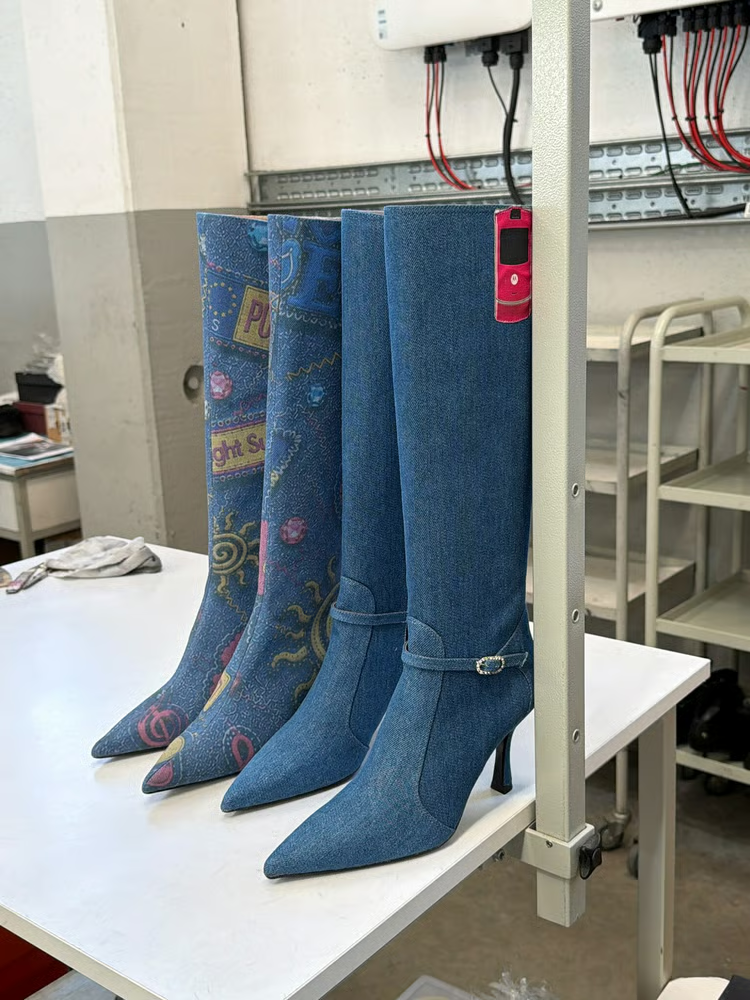
Styled by Colombian-Spanish stylist Caterina Ospina, the Swedish singer has had a pair of denim boots with a pink Motorola V3 Razr motif printed on the topline on rotation throughout her latest tour and string of festival appearances.
Few people and onscreen characters (together) have left such an indelible mark in pop culture.


